
Home › Blog › Ceylon Cinnamon vs Cassia: Benefits, Coumarin and How Much Per Day
Ceylon Cinnamon vs Cassia: Benefits, Coumarin and How Much Per Day
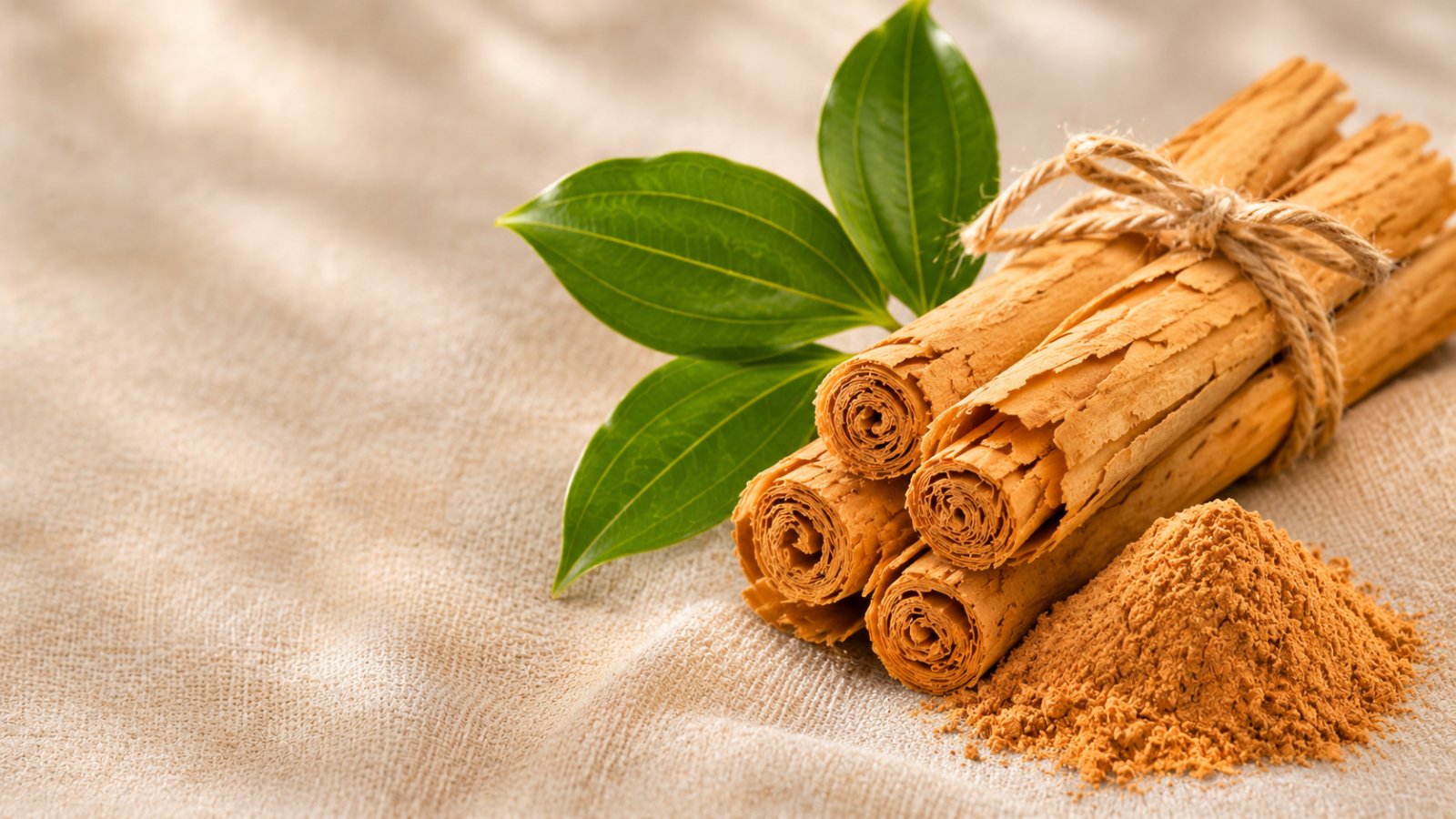
Most of the cinnamon sold in supermarkets is not Ceylon cinnamon. That matters for flavour, and it matters for safety if you use cinnamon every day. This guide answers the questions people search for most about Ceylon cinnamon, with sources at the end so you can check every figure.
The short answer: Ceylon cinnamon ("true cinnamon") comes from Sri Lanka, tastes milder and sweeter, and contains far less coumarin than cassia, the cheaper cinnamon found in most shops. Coumarin can harm the liver in large amounts, so Ceylon is the better choice for daily use. Research on cinnamon and blood sugar is promising but mixed, and cinnamon is not a treatment for any disease.
What is Ceylon cinnamon?
Ceylon cinnamon is the dried inner bark of Cinnamomum verum (also called Cinnamomum zeylanicum), a tree native to Sri Lanka. "Ceylon" is the old name of Sri Lanka, and the spice is often called true cinnamon.
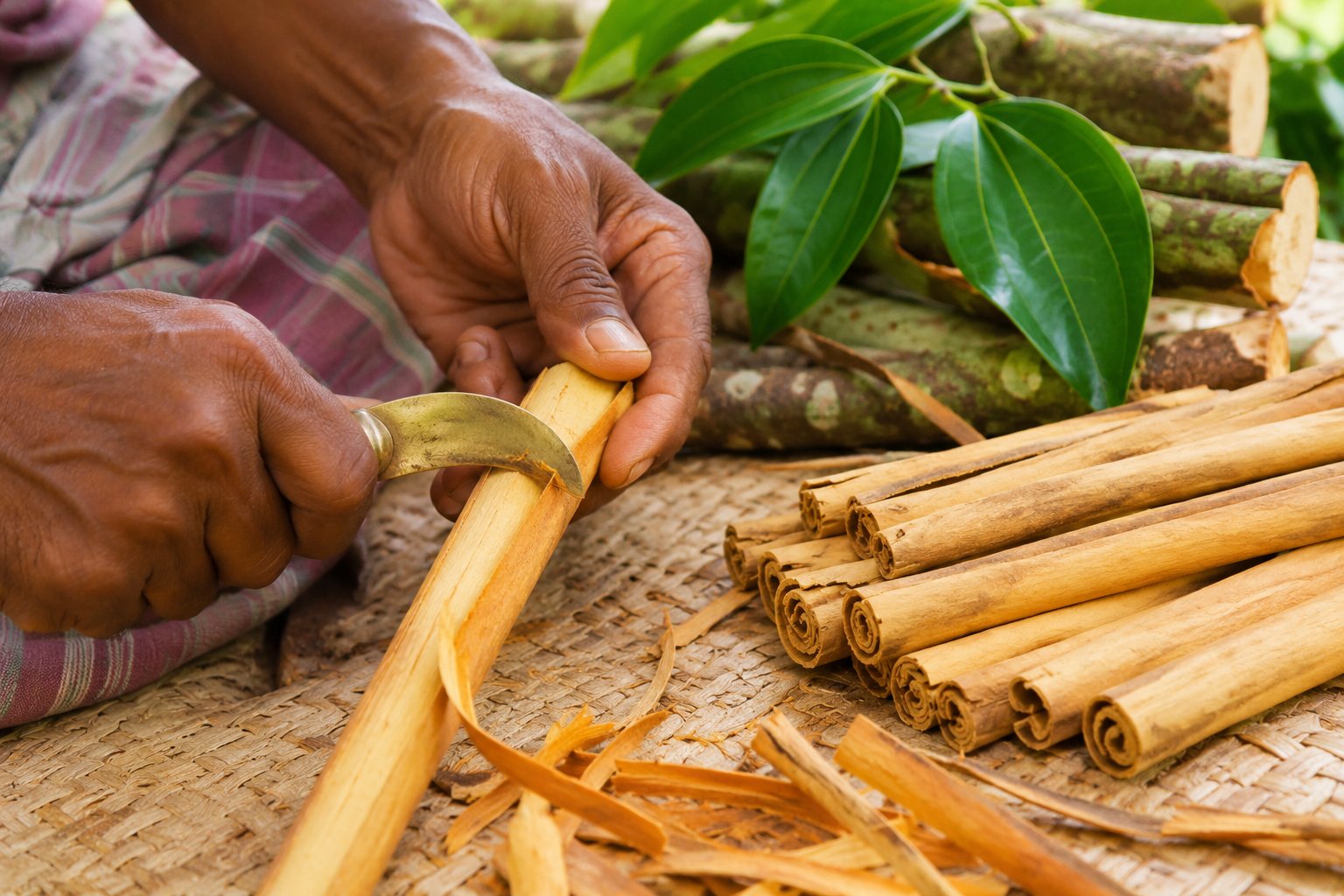
Peelers shave the thin inner bark from young shoots by hand, then roll many layers together into long, delicate quills. In 2022 the European Union registered "Ceylon Cinnamon" as a Protected Geographical Indication (PGI), so in the EU the name is reserved for cinnamon grown and processed in Sri Lanka.
What is the difference between Ceylon and cassia cinnamon?
Ceylon cinnamon is made from thin, papery layers of inner bark from Sri Lanka and tastes mild and sweet. Cassia covers several related species, mainly Cinnamomum cassia (Chinese cinnamon), plus Indonesian and Vietnamese types; it is cheaper to produce, has a stronger taste and contains far more coumarin, which is why it fills most supermarket shelves.
| Ceylon cinnamon | Cassia cinnamon | |
|---|---|---|
| Species | Cinnamomum verum | Cinnamomum cassia and related species |
| Main origin | Sri Lanka | China, Indonesia, Vietnam |
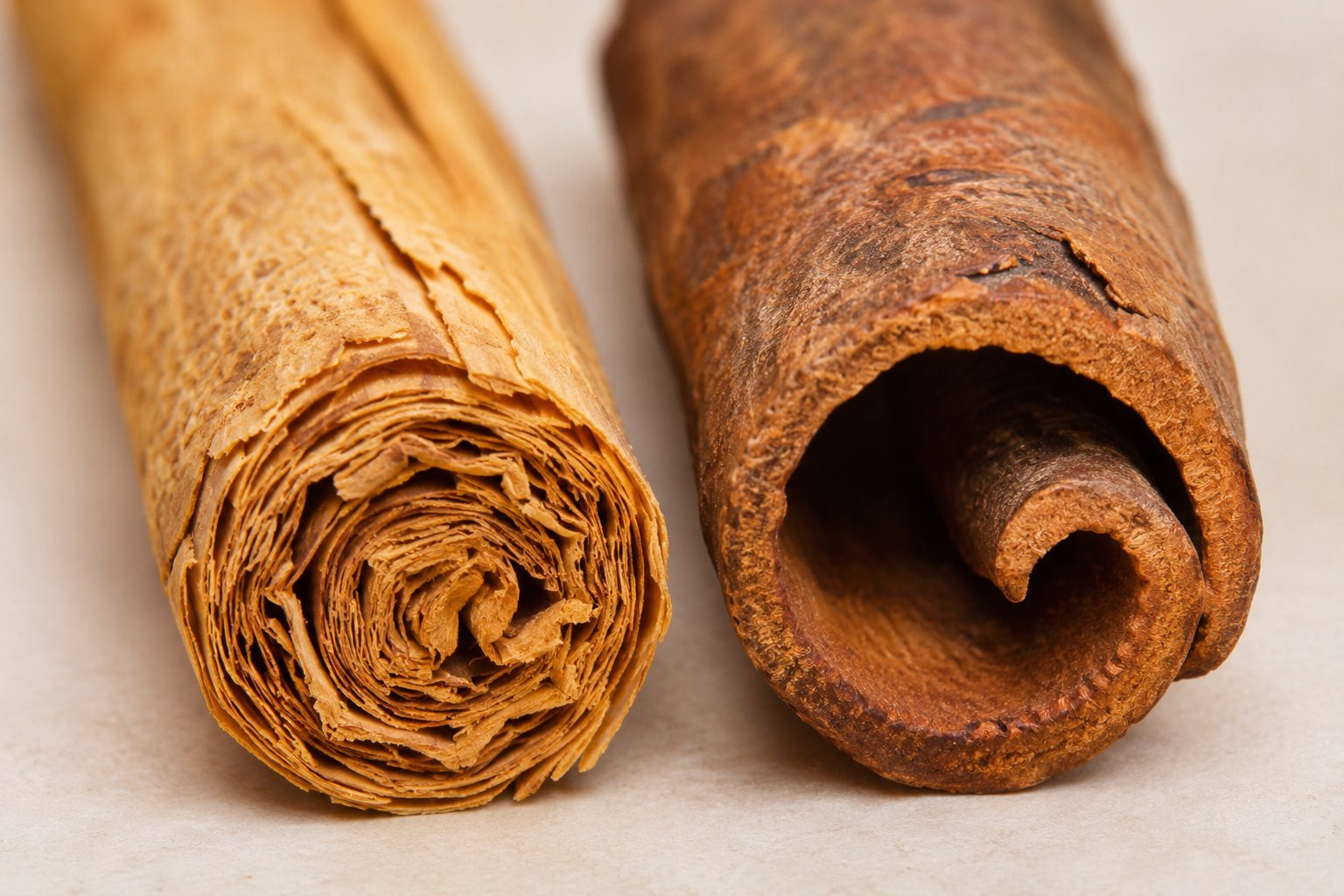
| Quill | Many thin, papery layers; crumbles easily | One thick, hard layer; hard to break |
| Colour | Light tan | Darker reddish-brown |
| Taste | Mild, sweet, complex, citrusy notes | Strong, spicy, slightly bitter |
| Coumarin | Very low (trace amounts) | High; around 100 times more than Ceylon |
| Price | Higher | Lower |
Is Ceylon cinnamon safer than cassia?
For regular, daily use, yes. The reason is coumarin, a natural compound that cassia contains in much larger amounts. In high doses coumarin can damage the liver, especially in sensitive people.
The European Food Safety Authority (EFSA) set a tolerable daily intake (TDI) of 0.1 mg of coumarin per kg of body weight, and kept it after re-evaluating it in 2008. Germany's Federal Institute for Risk Assessment (BfR) uses the same value.
Austria's food safety agency (AGES) measured 1,880–3,260 mg of coumarin per kg in cassia, while the highest value in Ceylon cinnamon was 185 mg per kg. In other words, cassia carries roughly a hundred times more.
What that means for a 60 kg adult (TDI = 6 mg coumarin a day): cassia at an average of about 2,900 mg/kg reaches the limit at roughly 2 g a day, less than one teaspoon. Ceylon, even at the highest measured 185 mg/kg, would take roughly 30 g a day to reach the same limit.
The US National Center for Complementary and Integrative Health (NCCIH) notes that cinnamon is likely safe in normal food amounts, but that long-term use of high-coumarin cassia could be a problem for sensitive people, such as those with liver disease.
How much Ceylon cinnamon per day is safe?
In normal food amounts, Ceylon cinnamon is well within safe limits for healthy adults. Half a teaspoon to one teaspoon a day (roughly 1–3 g) in tea, porridge or cooking is a typical, comfortable amount, far below the coumarin limit worked out above.
Take extra care if you:
- Take cinnamon supplements or capsules. They deliver much more than food use, and many are made from cassia. Check the species on the label.
- Have liver disease, are pregnant or breastfeeding, or take medicines for diabetes or blood clotting. Talk to your doctor before taking cinnamon in supplement amounts.
- Give cinnamon to small children. Because the limit is based on body weight, children reach it at much smaller amounts, which matters most with cassia.
What are the health benefits of Ceylon cinnamon?
Cinnamon has a long history in traditional medicine, including Sri Lankan Ayurveda, where it is used as a warming spice for digestion. Modern research has mainly looked at blood sugar, antioxidants and blood fats.
- Blood sugar. The most studied area; see the next section.
- Antioxidants. Cinnamon is rich in polyphenols, plant compounds with antioxidant activity in laboratory studies.
- Cholesterol and blood fats. Some reviews report small improvements, but the evidence is limited and inconsistent.
Two honest caveats. First, most human studies used cassia, not Ceylon, so the results don't automatically apply to true cinnamon. Second, NCCIH states that studies in people don't clearly support using cinnamon for any health condition. Enjoy Ceylon cinnamon as a flavourful, safer everyday spice, not as a medicine.
Does Ceylon cinnamon lower blood sugar?
Several meta-analyses of randomised trials found that cinnamon supplements modestly lowered fasting blood glucose in people with type 2 diabetes or prediabetes, but the trials varied a lot and most used cassia. Cinnamon is not a treatment for diabetes and must never replace prescribed medicine.
One 2019 analysis of 16 trials also found improved insulin resistance (HOMA-IR). However, the trials differed in dose, length and type of cinnamon, and the authors themselves urge caution. Results for long-term markers such as HbA1c are less consistent. If you have diabetes and want to add cinnamon regularly, choose Ceylon to keep coumarin low, and let your doctor know.
How can you tell if cinnamon is real Ceylon?
Ceylon quills are made of many thin, papery layers rolled together, are light tan and crumble easily; cassia sticks are a single thick, dark, hard layer. For powder, check the label for Cinnamomum verum or zeylanicum and Sri Lanka as the origin.
Cinnamon sticks (quills)
- Layers: Ceylon quills look like a rolled cigar of many thin, paper-like layers. Cassia is one thick, curled sheet.
- Texture: Ceylon crumbles in your fingers; cassia is hard and woody.
- Colour: Ceylon is light tan; cassia is darker reddish-brown.
Cinnamon powder
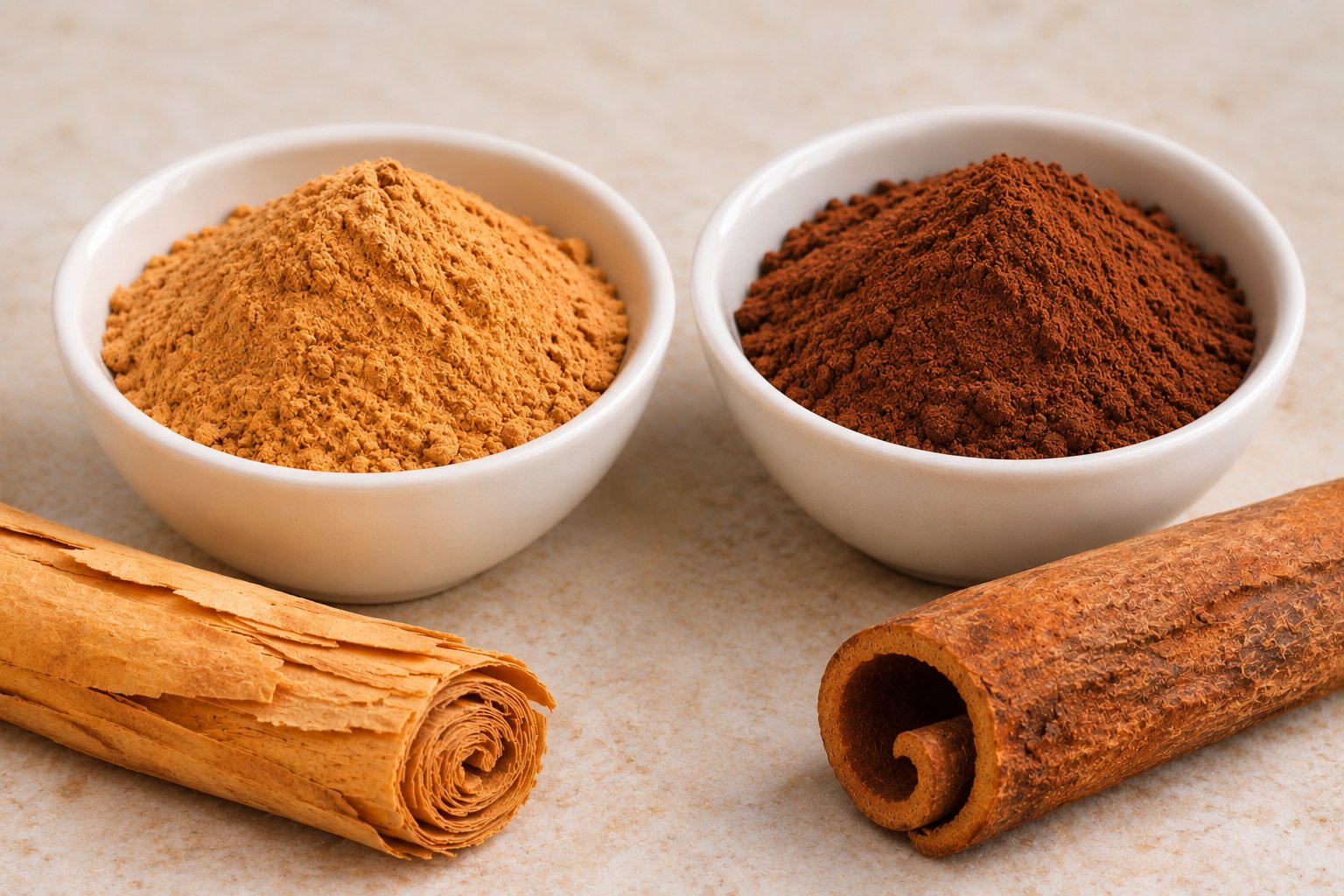
Powder is much harder to judge by eye. Ceylon powder is lighter in colour and smells sweeter, but the reliable checks are:
- The label names Cinnamomum verum or Cinnamomum zeylanicum, and Sri Lanka as the origin. "Cinnamon" alone usually means cassia.
- In the EU, look for the "Ceylon Cinnamon" PGI name and logo.
- For bulk buying, ask the supplier for a certificate of analysis that includes coumarin content.
What is the best way to use Ceylon cinnamon?
Ceylon cinnamon's gentle sweetness makes it easy to use every day: in herbal tea, porridge, smoothies, coffee, baking and Sri Lankan curries.
- Tea and herbal blends: on its own, or with ginger, turmeric or lemongrass.
- Breakfast: stirred into porridge, yoghurt, smoothies or overnight oats.
- Coffee and warm milk: a pinch in coffee, or in "golden milk" with turmeric.
- Baking: lighter and more fragrant than cassia in cakes and biscuits.
- Savoury cooking: a whole quill in Sri Lankan curries, rice, dhal and stews.
Store it in an airtight container away from light and heat. Quills keep their aroma longer than powder, so grind small amounts as you need them if you can.
How do you make Ceylon cinnamon tea?
Steep one broken Ceylon cinnamon quill, or half a teaspoon of powder, in 250 ml of freshly boiled water for 8–10 minutes (quills) or 3–5 minutes (powder), then strain.
- Break one Ceylon cinnamon quill (about 5–8 cm) into pieces, or use ½ teaspoon of powder.
- Pour 250 ml of freshly boiled water over it.
- Cover and steep for 8–10 minutes (quills) or 3–5 minutes (powder).
- Strain, then add lemon, ginger or a little honey if you like.
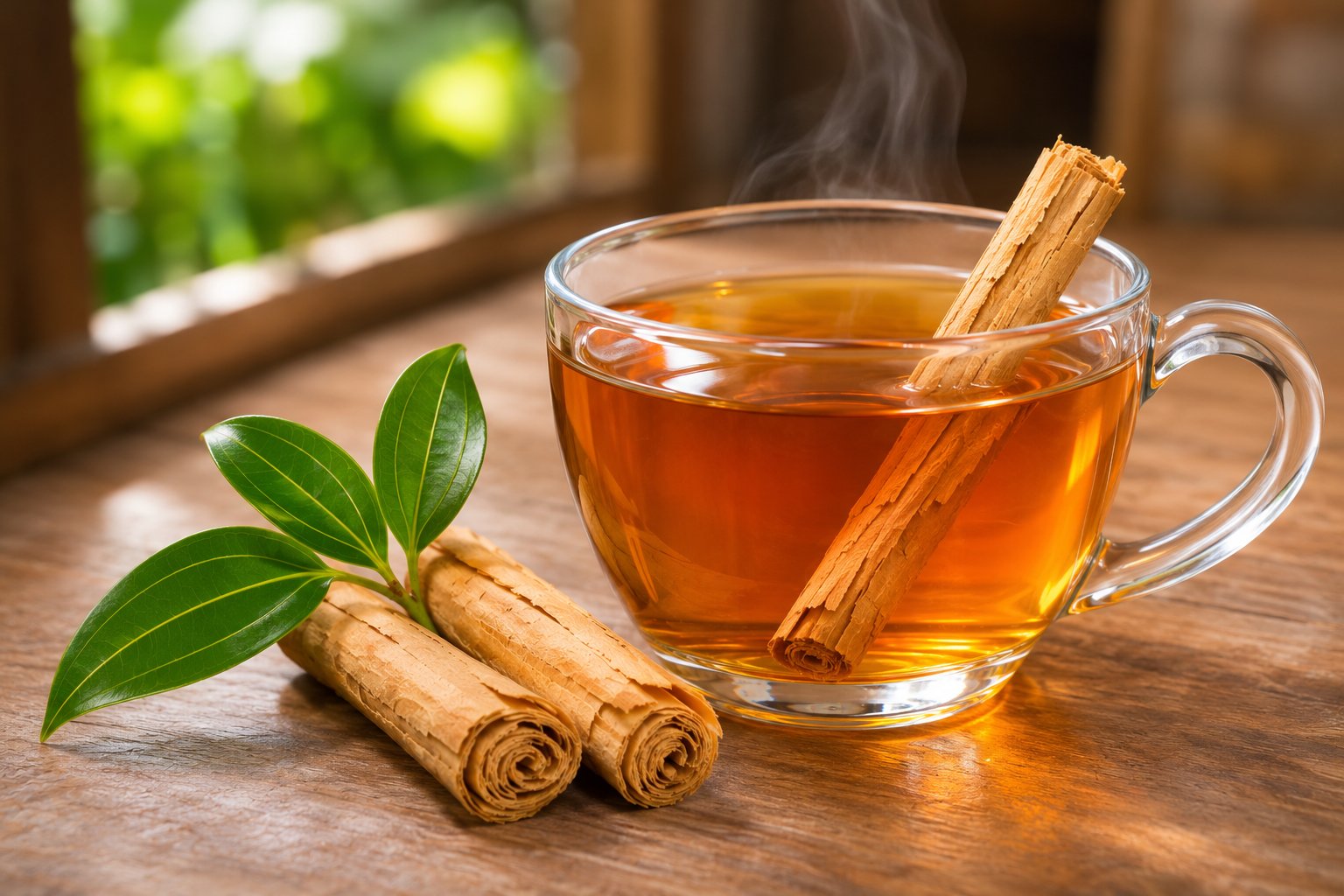
For a ready-made option, a Ceylon cinnamon and turmeric herbal blend combines true cinnamon with turmeric and a touch of black pepper.
Is Ceylon cinnamon worth the price?
If you use cinnamon every day, yes: Ceylon has far less coumarin, a more refined flavour and a protected origin. For occasional baking, cassia is fine.
If you use it in tea, porridge or a wellness routine, or if you sell cinnamon products to health-conscious customers, Ceylon is worth paying for: lower coumarin, a more refined flavour, and a clear origin story backed by the EU's PGI protection.
Sources
- AGES (Austrian Agency for Health and Food Safety). Coumarin.
- BfR (German Federal Institute for Risk Assessment). High daily intakes of cinnamon: health risk cannot be ruled out.
- NCCIH (US National Institutes of Health). Cinnamon: usefulness and safety.
- Meta-analysis of 16 randomised trials on cinnamon and glycaemic control (2019). PubMed 31425768.
- Meta-analysis of 18 studies on cinnamon supplementation and glucose (2019). PubMed 30935562.
- Umbrella review of cinnamon's efficacy and safety, Frontiers in Pharmacology (2022). PMC8804376.
- European Commission Implementing Regulation (EU) 2022/144 registering "Ceylon Cinnamon" (PGI). EUR-Lex.
Sourcing Sri Lankan herbs for your brand?
Sheora Ceylon supplies herbal teas, herbal powders and Ceylon spices from Sri Lanka in bulk, white label and private label. Samples and certificates of analysis are available on request.
Send an inquiryThis article is for general information only and is not medical advice. Talk to a qualified health professional before using herbs or herbal products to manage a health condition, especially if you are pregnant, have a medical condition or take medication.